Stability AI · model directory
What Is Stable Diffusion? The open model everything else borrowed from
Stable Diffusion is an openly released latent diffusion model from Stability AI. What latent diffusion means, and why open weights mattered so much.
Stable Diffusion at a glance
- Maker
- Stability AI
- Architecture
- Latent diffusion
- Weights
- Open, downloadable
- Runs on
- Consumer GPUs
- Known for
- Its ecosystem
- Extensions
- LoRA, ControlNet, checkpoints
What "latent diffusion" means, without the mathematics
A diffusion model learns by watching pictures get destroyed. Take a photograph, add a little noise, add more, keep going until nothing but static remains, and train a network to predict what was removed at each step. Run that network backwards from pure static and it paints a picture that was never there.
Doing this at full resolution is enormously expensive, because every step operates on every pixel. The latent trick is to compress the image first into a much smaller representation that keeps the structure and throws away the exact pixels, run the whole noisy process in that small space, and only decode back to a real image at the very end.
That single decision is why any of this reached ordinary people. It cut the cost of generation by roughly an order of magnitude and brought image generation onto hardware someone might already own, rather than a rented cluster.
Open weights, and what they set off
Stability released the model files themselves rather than only an API. That is the fact with the longest consequences, and it is easy to underrate now that the results are everywhere.
Because anyone could inspect and modify the model, people built the layer of control that the base model lacked. LoRAs made it possible to teach a specific style or subject with a small add-on file instead of retraining anything. ControlNet made it possible to constrain a generation to a pose, a depth map or an edge drawing. Community checkpoints specialised the base model for illustration, photography, architecture and everything else.
The vocabulary that came out of that period is now how people talk about image generation generally — seed, sampler, denoise strength, CFG, inpainting. Those words were popularised by an open community reading and rewriting a model they could actually open, and they are why the glossary on this site is written the way it is.
What running it yourself is genuinely like
Better than it was and still not casual. There are one-click installers and there are node-based interfaces of real complexity, and the distance between "I generated a picture" and "I got the picture I wanted" is where the time goes.
The reward is control that hosted products do not offer: exact seeds, arbitrary resolutions, any checkpoint or LoRA you like, no content pipeline between you and the output, no per-image cost after the hardware, and nothing leaving your machine.
The cost is that you are now operating a small piece of infrastructure. Model files run to several gigabytes each, extensions break against each other, and a graphics card with enough memory is the entry ticket. People who want an image tend to be happier with a hosted model; people who want a process are the ones who stay.
Where it stands now
It is no longer automatically the strongest option on raw output quality, and several newer models — including FLUX, built in part by people who worked on Stable Diffusion — read prompts more literally and render legible text far better.
What it retains is the ecosystem. The volume of community checkpoints, style adapters and control tooling built on the older versions is not something a newer model acquires quickly, and for anyone with a specific style to reproduce or a pipeline already built, that inventory outweighs a general quality gap.
Successive versions have also shipped under progressively more conditional licences than the early releases, which is worth checking against your intended use rather than assuming. "Open weights" and "free for anything" stopped being the same statement some time ago.
Reading the rest of this site through it
Almost every technique page here uses terms this model popularised. Denoise strength decides how far an image-to-image result departs from its input. A seed makes a generation repeatable. Inpainting edits inside a mask and leaves the rest untouched. Those concepts apply whatever model you eventually use.
That is the honest reason to understand Stable Diffusion even if you never install it: it is the model whose interface leaked into the language. Learn it once and every other tool becomes easier to read.
The open model
Why releasing the weights mattered more than the model did
The technical achievement was making diffusion cheap enough for a consumer graphics card. The consequential decision was publishing the files so anyone could open them.
Everything downstream — LoRAs, ControlNet, community checkpoints, the whole vocabulary of seeds and samplers — exists because thousands of people could read and modify a working image model instead of querying one through a slot.
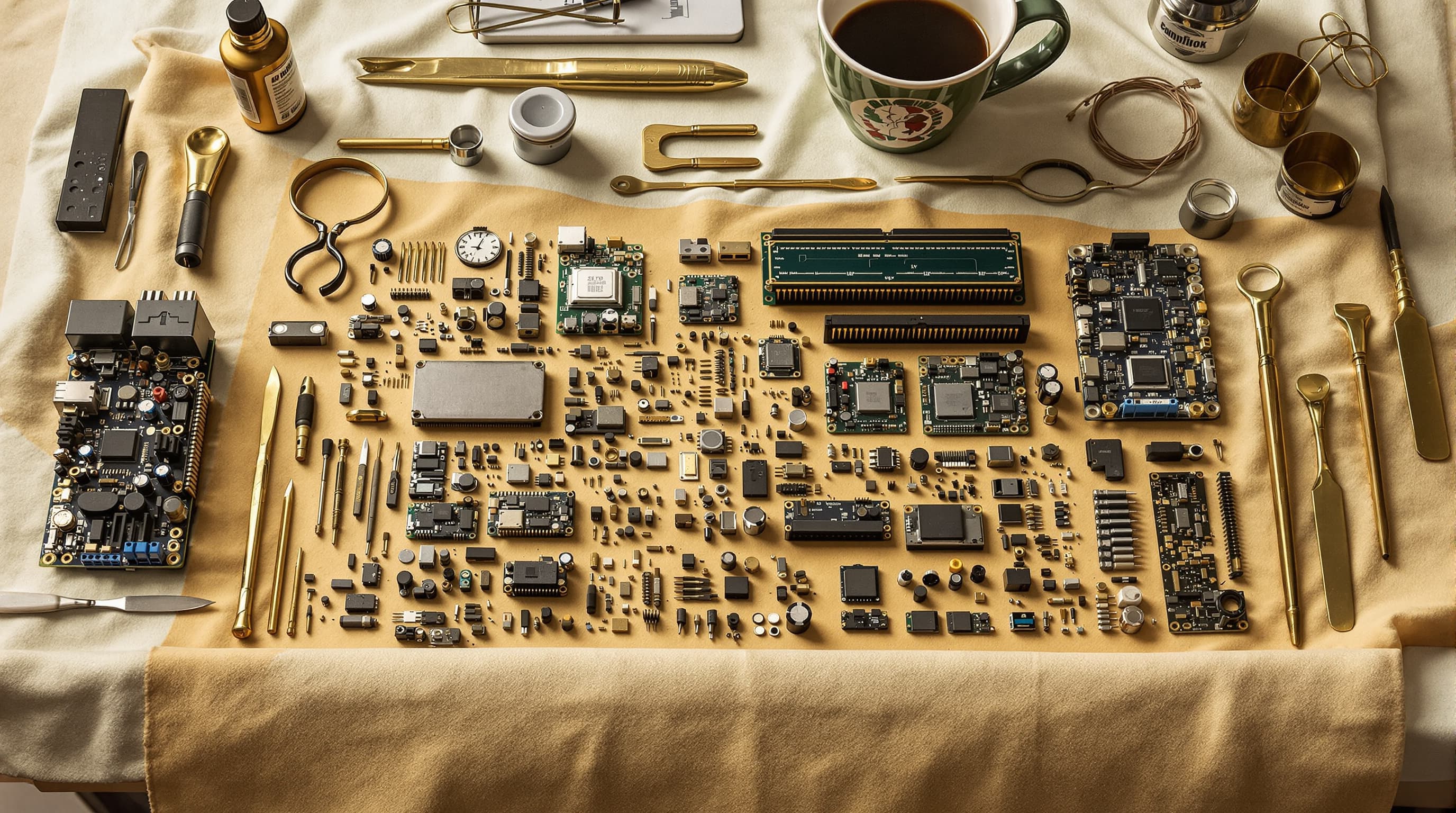
Three layers of the ecosystem
What people actually add on top of the base model
Swapping the model itself
A checkpoint is the whole set of weights. Fine-tuning the base on a narrower body of images — photography, illustration, architecture — produces a model with a different default character and different competencies.
You load exactly one at a time, and it is the decision with the largest effect on what comes out.
- Several gigabytes each.
- One loaded at a time.
- Licences and provenance vary widely.
Adding one thing without retraining
A small file that teaches the loaded checkpoint a specific style, character or object. Trainable on a single consumer card in minutes to hours.
Several can be stacked with individual weights, which is where most of the practical difficulty lives — two strong style LoRAs fight each other.
- Tens to hundreds of megabytes.
- Stackable, with adjustable strength.
- Tied to a specific base architecture.
Fixing structure, freeing everything else
Constrains a generation to a structural input — a pose skeleton, a depth map, an edge drawing — so composition is decided by you and the rest by the model.
This is the capability that turned image generation from sampling into direction, and it has no clean equivalent in most hosted products.
- Pose, depth, edges, segmentation.
- Composition fixed, style free.
- The main reason people self-host.
Stable Diffusion questions
What to know before installing anything
The questions that decide whether self-hosting is for you.
What hardware do I actually need?
Video memory is the binding constraint rather than raw speed. Older cards with generous memory often outperform newer ones with less for this workload.
Is it still worth learning?
If you need reproducibility, volume, privacy or structural control, yes. If you want good images with no setup, a hosted model gets you there faster.
Which version should I use?
It depends entirely on which ecosystem you need. Older versions have vastly more community tooling; newer ones have better base quality and more conditional licences.
Can I use the output commercially?
Check the licence of the specific version and of every checkpoint and LoRA in the stack. "Open weights" and "free for anything" stopped being the same statement some time ago.
Why do my results look worse than the examples?
Almost always the checkpoint rather than the prompt. Community examples are usually generated on a heavily fine-tuned checkpoint rather than the base model.
Is it being replaced by FLUX?
On output quality it has largely been overtaken. On the inventory of checkpoints, adapters and control tooling, nothing has replaced it yet.
The terms this model named
Vocabulary that came out of the open ecosystem
Keep exploring
Elsewhere on LaFoto
The concepts here apply whatever you end up running.
- resize an image
- JPG, PNG and WebP
- image compressor
- crop to a ratio
- colour picker from image
- remove a background
- EXIF viewer
- AI prompt generator
- anime AI generator
- cartoonize a picture
- make pixel art
- the ranked comparison
- compared with Midjourney
- LaFoto vs Leonardo AI
- compared with Ideogram
- compared with Canva
- reproducing an image
- how far a result may drift
- editing inside a mask
- the LaFoto journal
Stable Diffusion — questions people ask
- What is Stable Diffusion?
- An openly released text-to-image model from Stability AI, based on latent diffusion, which can be downloaded and run on consumer hardware rather than only accessed through an API.
- Is Stable Diffusion free?
- The weights have been openly released and can be run locally at no per-image cost, but licence terms differ between versions and later releases carry more conditions. Check the licence for the specific version against your intended use.
- What does latent diffusion mean?
- The model does its work on a compressed representation of an image rather than on full-resolution pixels, then decodes to an image at the end. That is what made it cheap enough to run on an ordinary graphics card.
- What is a LoRA in Stable Diffusion?
- A small add-on file that teaches the base model a specific style, subject or character without retraining the whole model. It is the standard way the community shares specialisations.
- What is ControlNet?
- An extension that constrains a generation to a structural input such as a pose skeleton, a depth map or an edge drawing, so you can fix composition while letting the model decide everything else.
- Do I need a good graphics card to run Stable Diffusion?
- To run it locally, yes — video memory is the binding constraint. Hosted services remove that requirement at the cost of the control that running it yourself provides.
- Is Stable Diffusion still the best image model?
- Not on raw output quality; newer models generally follow prompts more literally and render text better. Its advantage now is the depth of community tooling built around it.
- Why do people talk about seeds and samplers?
- Those are controls the open community surfaced and named while working with this model, and the vocabulary spread from there to the rest of the field.
The other models in the directory
Start creating today
Generate your first image with the best AI image generator.
Turn a sentence into a finished, photorealistic image in seconds — then refine every detail. No setup, no Discord, no GPU.
Join 4,200+ creators using LaFoto